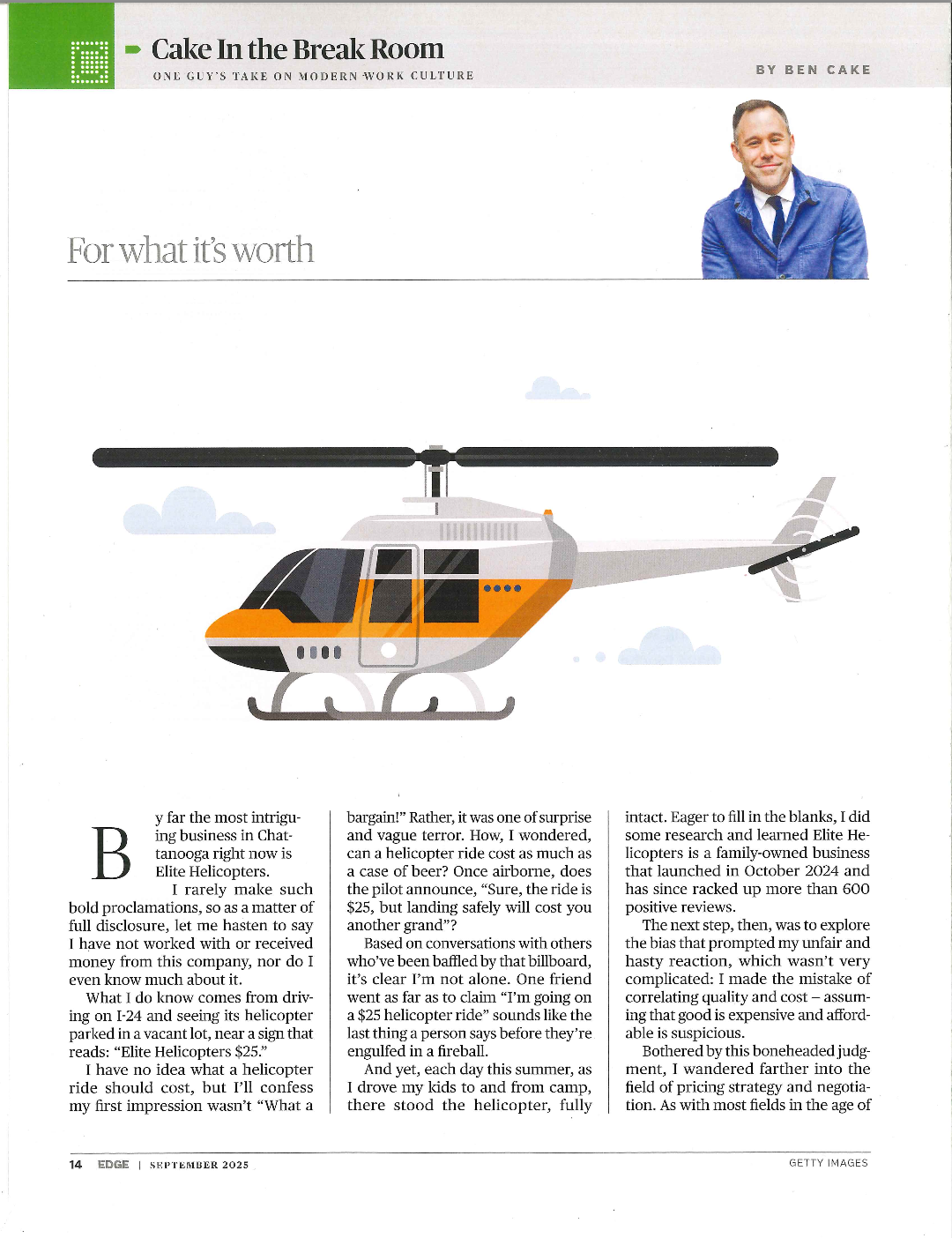
BY FAR THE MOST INTRIGUING BUSINESS in Chattanooga right now is Elite Helicopters.
I rarely make such bold proclamations, so as a matter of full disclosure, let me hasten to say I have not worked with or received money from this company, nor do I even know much about it.
What I do know comes from driving on I-24 and seeing its helicopter parked in a vacant lot, near a sign that reads: “Elite Helicopters $25.”
I have no idea what a helicopter ride should cost, but I’ll confess my first impression wasn’t “What a bargain!” Rather, it was one of surprise and vague terror. How, I wondered, can a helicopter ride cost as much as a case of beer? Once airborne, does the pilot announce, “Sure, the ride is $25, but landing safely will cost you another grand”?
Based on conversations with others who’ve been baffled by that billboard, it’s clear I’m not alone. One friend went as far as to claim “I’m going on a $25 helicopter ride” sounds like the last thing a person says before they’re engulfed in a fireball.
And yet, each day this summer, as I drove my kids to and from camp, there stood the helicopter, fully intact. Eager to fill in the blanks, I did some research and learned Elite Helicopters is a family-owned business that launched in October 2024 and has since racked up more than 600 positive reviews.
The next step, then, was to explore the bias that prompted my unfair and hasty reaction, which wasn’t very complicated: I made the mistake of correlating quality and cost—assuming that good is expensive and affordable is suspicious.
Bothered by this boneheaded judgment, I wandered further into the field of pricing strategy and negotiation. As with most fields in the age of influencers, it is populated by a wide assortment of characters, ranging from scholars to scammers. Among those providing (seemingly) credible information is Dan Ariely, whose book Predictably Irrational shares insightful research about how and why we not only “make astonishingly simple mistakes every day, but…consistently overpay, underestimate…and fail to understand the profound effects of our emotions on what we want.” On the other end of the spectrum are those seeking social-media applause with advice like, “The amount you ask for is always the highest amount you can say out loud without actually bursting out laughing.”
Between the nuanced studies of behavioral economists and one-liners that aren’t that much more sophisticated than L’Oréal’s ad line “Because I’m worth it,” the latter are much more popular. Current wisdom seems to believe no one really knows what anything is worth and the greatest crime a person can commit is leaving money on the table. Thus, heaving out a large dollar figure will get dummies like me to assume it’s a reflection of real substance.
Perhaps the most conspicuous examples of this phenomenon appear in the form of business “valuations”—particularly with start-ups, where value is often derived from raising impressive sums rather than earning them.
That trend, however, might be turning, as I’ve noticed the phrase “once worth” appearing in more and more headlines. For instance, the publication SFGate has run a slew of these stories in recent weeks, including: “San Francisco Tech Company Forward, Once Worth $1B, Abruptly Shuts Down,” “SF tech company Tally, Once Worth $855 Million, Shuts Down Amid Wave of Complaints,” and “Calif.-Founded EV Maker Canoo, Once Worth $2.4 billion, Goes Belly-up After Moving to Texas.”
It would appear from the number of very public crashes, high-flying startups are much less reliable than Elite Helicopters.
Which brings us back to Chattanooga’s most intriguing company. In an age when overpromising, under-delivering, and asking for a bundle in the process has become a template for success, it’s worth applauding a small, family-owned business that makes a unique experience accessible to many.
Put another way: They offer rides, without taking customers for a ride. I’m now a fan of the business and its pricing strategy. For everyone’s sake, I hope it gets off the ground.