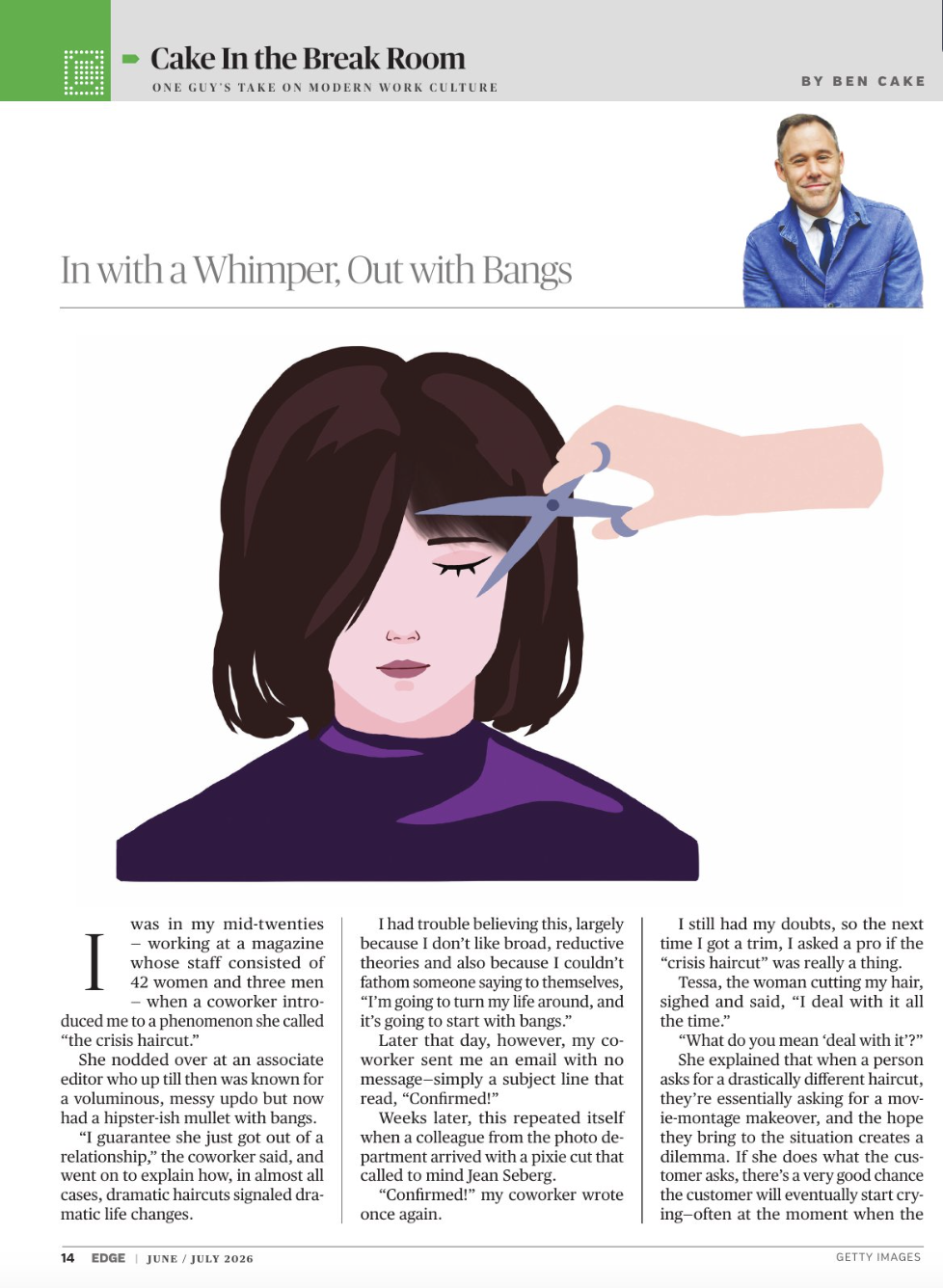
I WAS IN MY MID-TWENTIES—working at a magazine whose staff consisted of 42 women and 3 men—when a coworker introduced me to a phenomenon she called “the crisis haircut.”
She nodded over at an associate editor who up till then was known for a voluminous, messy updo but now had a hipster-ish mullet with bangs.
“I guarantee she just got out of a relationship,” the coworker said, and went on to explain how, in almost all cases, dramatic haircuts signaled dramatic life changes.
I had trouble believing this, largely because I don’t like broad, reductive theories and also because I couldn’t fathom someone saying to themselves, “I’m going to turn my life around, and it’s going to start with bangs.”
Later that day, however, my coworker sent me an email with no message—simply a subject line that read, “Confirmed!”
Weeks later, this repeated itself when a colleague from the photo department arrived with a pixie cut that called to mind Jean Seberg.
“Confirmed!” my coworker wrote once again.
I still had my doubts, so the next time I got a trim, I asked a pro if the “crisis haircut” was really a thing.
Tessa, the woman cutting my hair, sighed and said, “I deal with it all the time.”
“What do you mean ‘deal with it’?”
She explained that when a person asks for a drastically different haircut, they’re essentially asking for a movie-montage makeover, and the hope they bring to the situation creates a dilemma. If she does what the customer asks, there’s a very good chance the customer will eventually start crying—often at the moment when the reality of the haircut doesn’t match the imagined moment of transformation. At the same time, it’s difficult to tell someone they don’t really want what they think they want.
“So what do you do?” I asked.
Tessa explained that after a few awkward encounters, she developed the personal credo “No shitty haircuts,” which meant she would do everything she could to delicately establish what was (and what was not) possible to achieve with scissors.
In addition to asking a lot of questions, she would discuss the shape of the person’s face and the thickness of their hair. She would discuss how much product or blow-drying the style would require. She would talk about the process of growing it out. Overall, she wanted to place the focus on the practical realities of the haircut as opposed to the idea the haircut was intended to symbolize. She knew the customer wanted a fresh start but also believed there was more than one way to create that feeling.
As I listened, I recognized that Tessa’s job required at least three distinct skill sets: the technical skill of cutting hair, the strategic skill of assessing whether a style would work for a particular person, and the communication skills necessary to create a shared understanding about a decision that was complicated by many layers of emotion.
This conversation with Tessa occurred almost twenty years ago, but I think about it all the time, especially as sales-pitch promises seem to become more grandiose, deliverables become more disappointing, and trust creeps toward extinction.
A significant part of the problem is that our basic financial incentives rarely reward slowing down or running the risk of discouraging a sale with something as naive as practicality.
Recently, for instance, I had one creative director tell me, “We don’t have time to consider all the unintended consequences of this project.” Another told me, “We could play therapist with these guys for months, but it won’t get us anywhere. We just need to get this done.”
Both of these projects involved hefty price tags, and both involved companies seeking to make superficial branding changes when what they really needed to do was make internal changes. Without question, both clients were shorn like sheep.
If a business is going to last, it needs to think of its clients less like items on a checklist and more like partners equally committed to the credo “No shitty haircuts.”
At the very least, that approach can prevent our long-term relationships from turning ugly.