IN 1957, U.S. News & World Report ran a headline that made a rather frank statement about the value of boomers: “A Bonanza for Industry—Babies. Sixty Million More U.S. Consumers in Next Nineteen Years.”
And while it would be absurd to suggest one headline reflects a consensus of that period, in his 1960 book, The Waste Makers, social critic Vance Packard devoted a chapter to the prevalence of this view: “The nation’s growing population,” he wrote, “was widely perceived by exultant businessmen as a built-in guarantee of long-term prosperity and as a main prop of the expanding economy.”
Here we see people, as soon as they entered the world, reduced to the label of “consumers” and “props.” In the minds of “exultant businessmen,” these babies existed to serve the economy, rather than the economy existing to support them. Boomers didn’t seem to mind, though, and, to their credit, they nailed the assignment. They have made and spent historic amounts. And since its inception in 1957, the S&P 500 has, on average, returned more than 10 percent a year.
But as helpful as those babies have been to the economy, enthusiasm about newer babies took a hard turn during the Great Recession. Compare, for instance, the headline above with this comment from a 2009 Wall Street Journal article: “It is commonly said that buying a house is the biggest purchase most Americans will ever make. Having a baby is like buying six houses. Except that they don’t increase in value, you can’t sell them, and after 16 years they’ll probably say they hate you.”
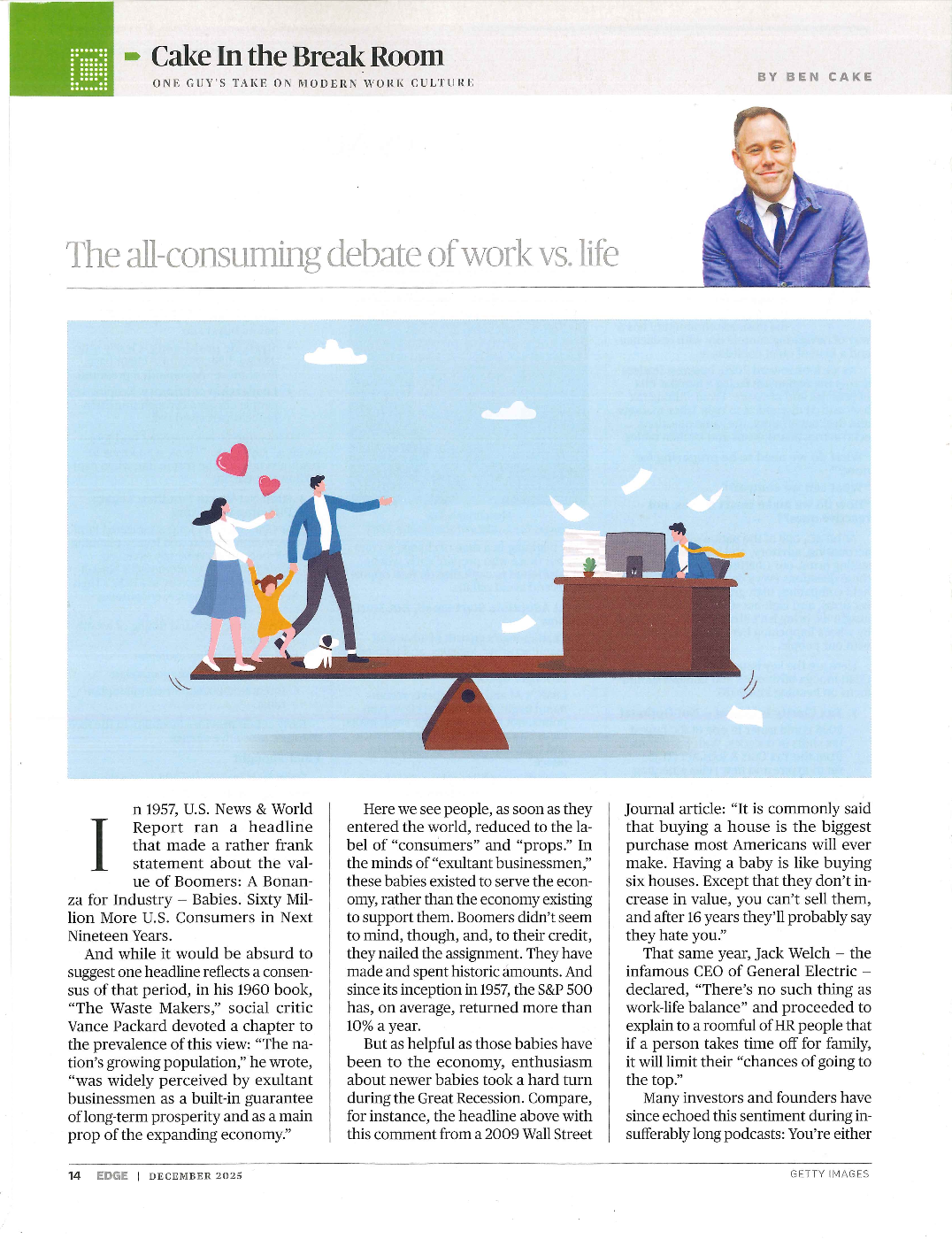
That same year, Jack Welch—the infamous CEO of General Electric—declared, “There’s no such thing as work-life balance” and proceeded to explain to a roomful of HR people that if a person takes time off for family, it will limit their “chances of going to the top.”
Many investors and founders have since echoed this sentiment during insufferably long podcasts: You’re either all in or all out. And while this might seem like the typical tug-of-war between labor and capital, it’s much bigger than that, because the short-term fixation on productivity and ROI is foreclosing the longer-term “prosperity” that comes with thriving communities in which multiple generations support one another.
As younger Americans contend with overwhelming student-loan debt, rising costs, an uncertain job market, and a dating environment one single friend described as “endlessly disappointing,” they’re opting out of once-important unpaid projects such as finding a partner, starting a family, or simply building a support structure of friends.
Combined with what’s being called the “silver tsunami”—a term that refers to the 73 million Americans (almost 25 percent of the population) leaving the workforce and entering their twilight years—executives, economists, and think-tankers are now bemoaning the “birth dearth” and projections indicating a looming population decline.
What will happen without more “consumers”?
Some fixes have been offered: Tech companies, of course, hype AI as the answer to pesky labor issues such as having to pay people, and Elon Musk has attempted to singlehandedly address population concerns by breeding with any woman willing to sign a nondisclosure agreement.
Ultimately, though, the work-life deniers can’t have it both ways: They can’t coerce people to put in 70-hour weeks, then replace them with robots, and then expect those people to participate in prodigal spending while littering the world with their offspring.
So, despite Mr. Musk’s efforts, another option might involve thinking about, you know, life.
When I began this piece, news outlets had just announced the passing of Diane Keaton, one of many iconic figures who have died this year, including David Lynch, Val Kilmer, Sly Stone, Giorgio Armani, and Robert Redford. Soon we will attend funerals with the frequency we attended weddings in our twenties and thirties. In these difficult moments, we will have the opportunity—both individually and collectively—to discuss and reconcile what it means to live a good, full life. A life beyond the numbers. More important, we will have the opportunity to confront the question of “What are people for?”
As a parent of two boys, I hope our collective response to that question is more nuanced than, “Creating value for shareholders.”