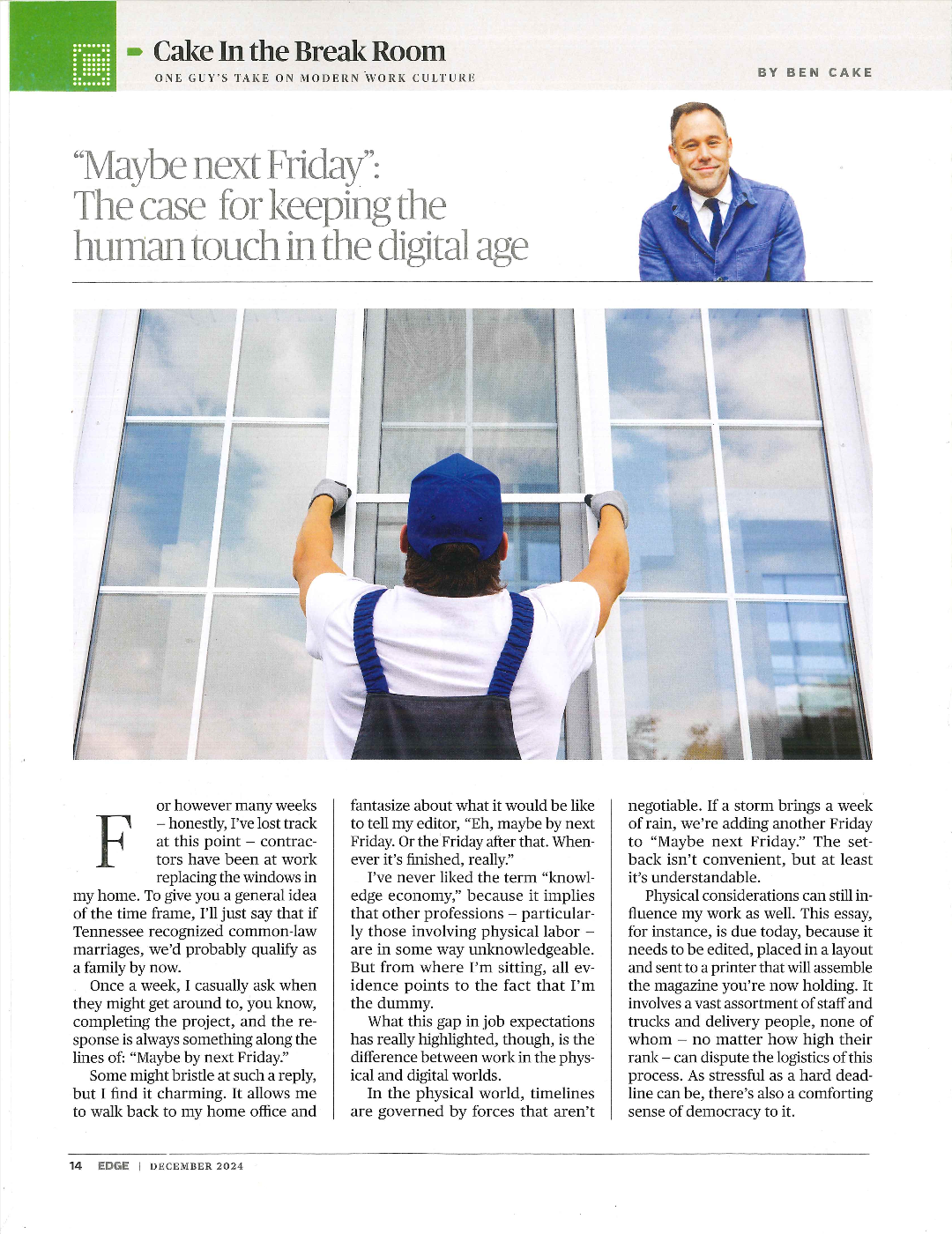
FOR HOWEVER MANY WEEKS—honestly, I’ve lost track at this point—contractors have been at work replacing the windows in my home. To give you a general idea of the time frame, I’ll just say that if Tennessee recognized common-law marriages, we’d probably qualify as a family by now.
Once a week, I casually ask when they might get around to, you know, completing the project, and the response is always something along the lines of: “Maybe by next Friday.”
Some might bristle at such a reply, but I find it charming. It allows me to walk back to my home office and fantasize about what it would be like to tell my editor, “Eh, maybe by next Friday. Or the Friday after that. Whenever it’s finished, really.”
I’ve never liked the term “knowledge economy,” because it implies that other professions—particularly those involving physical labor—are in some way unknowledgeable. But from where I’m sitting, all evidence points to the fact that I’m the dummy.
What this gap in job expectations has really highlighted, though, is the difference between work in the physical and digital worlds.
In the physical world, timelines are governed by forces that aren’t negotiable. If a storm brings a week of rain, we’re adding another Friday to “Maybe next Friday.” The setback isn’t convenient, but at least it’s understandable.
Physical considerations can still influence my work as well. This essay, for instance, is due today, because it needs to be edited, placed in a layout, and sent to a printer that will assemble the magazine you’re now holding. It involves a vast assortment of staff and trucks and delivery people, none of whom—no matter how high their rank—can dispute the logistics of this process. As stressful as a hard deadline can be, there’s also a comforting sense of democracy to it.
But as more and more of our production migrates to the digital world, timelines have begun to detach from the logic of the physical world, gravitating instead to the influence of a single individual’s “vision.” This is why it’s no longer surprising to read a story about, say, Elon Musk sending an email to his staff at two o’clock in the morning that demands they become “extremely hardcore” and “work long hours at high intensity.”
Here we see the “because” that once had a basis in logistics replaced with “because I said so.” And a growing zeal for automation has only encouraged this stance. Many in the technology sector, which has long waved the flag of “solving problems,” have decided that people are the problem when it comes to efficiency.
As my laid-back approach to the window project might suggest, all my instincts suggest this cynical, hard-line view—in which all obstacles should be dominated—will only lead to resentment, shortcuts, and wild inefficiency.
A recent fluke reinforced these beliefs: One of the contractors left a notebook in our kitchen, and I mistook it for my son’s homework. Instead, I found resolutions—“Make a difference,” “Be positive,” “You are in control of you”—followed by a few pages of workout routines, which were abruptly interrupted by tasks related to settling the estate of someone who had passed away.
It was a portrait of modern adulthood—sincere intentions sidelined by unexpected non-negotiables. This is the human factor, as natural as rainfall, and we all have some version of this notebook.
Champions of automation might say this is a soft-hearted “loser” mindset, and that it’s foolish to stand in the way of progress. But I’m not yet convinced denying another person’s humanity is a reasonable trade-off for “more, faster, cheaper.”
My biggest concern about the shift toward automation is that the more we interface with machines, the more tempted we become to expect people to either function like machines or be replaced.
In this light, we’re racing toward a new deadline that involves deciding how we’re willing to treat one another. Given the stakes, it’d be nice if we could slow down and get a better idea of what will be gained and lost.
At the very least, perhaps we could push it back a few more Fridays.