THE MOST IMPORTANT LESSON I learned from college came three days after I graduated, when I started working at the front desk of a fitness club. It took only a few minutes—wearing a name tag mistakenly spelled “Ben Lake”—to realize that while tweedy professors might indulge my thoughts on Heidegger and Kierkegaard, the rest of the world was not yet convinced I could do anything more complicated than scan membership cards and hand people towels.
I was a go-getter, though, and after two months of scanning and handing with gusto, I got promoted to assistant manager, earning tens of dollars a day. This was no doubt a bleak start to a career, but what the job lacked in the potential for prosperity, it made up for by highlighting an important insight: aspirational consumption is often a waste.
I worked at that club through two holiday seasons, a boom time for the sales reps who secured bonuses by assuring prospects our fancy equipment would enable them to get fit by spring break. Meanwhile, among the fitness staff, who did not benefit from the same commission structure, it was well-known that if a person showed up in January with brand-new sneakers, we would never see them or their sneakers after Valentine’s Day.
This iron law of the fitness world—that the excess of one’s gear signals a deficit of commitment—is formally known as gear acquisition syndrome, or GAS, a term coined by Walter Becker in a scholarly publication named Guitar Player.
It’s worth noting that Becker, the guitarist for Steely Dan, did not have to write this article. His musical career was doing fine. It’s just that he felt compelled to call out a near-pathological condition in which guitarists spend more time searching for that magical next instrument—the one that will help them achieve everything the previous eight guitars failed to—than practicing.
But this affliction is not limited to those who play scales or those afraid of stepping on a scale. It’s just as prevalent in the business world, with companies continually eyeing the latest data-visualization tools, software suites, chatbots, and other cloud-based claptrap.
A marketing company I once did some business with, for instance, tried out four different project-management tools over the course of six months, before settling on one that ultimately had no effect on productivity or morale. Each of these products required weeks spent researching, thousands spent on licensing, and days spent training staff—just so they could have new ways to passive-aggressively stress one another out.
The lure of acquisition is understandable. New equipment carries a romantic sense of potential that inspires the mind to create a movie-style montage of progress and success. Unfortunately, the ideas one indulges while shopping have nothing to do with the messier reality of putting something into practice.
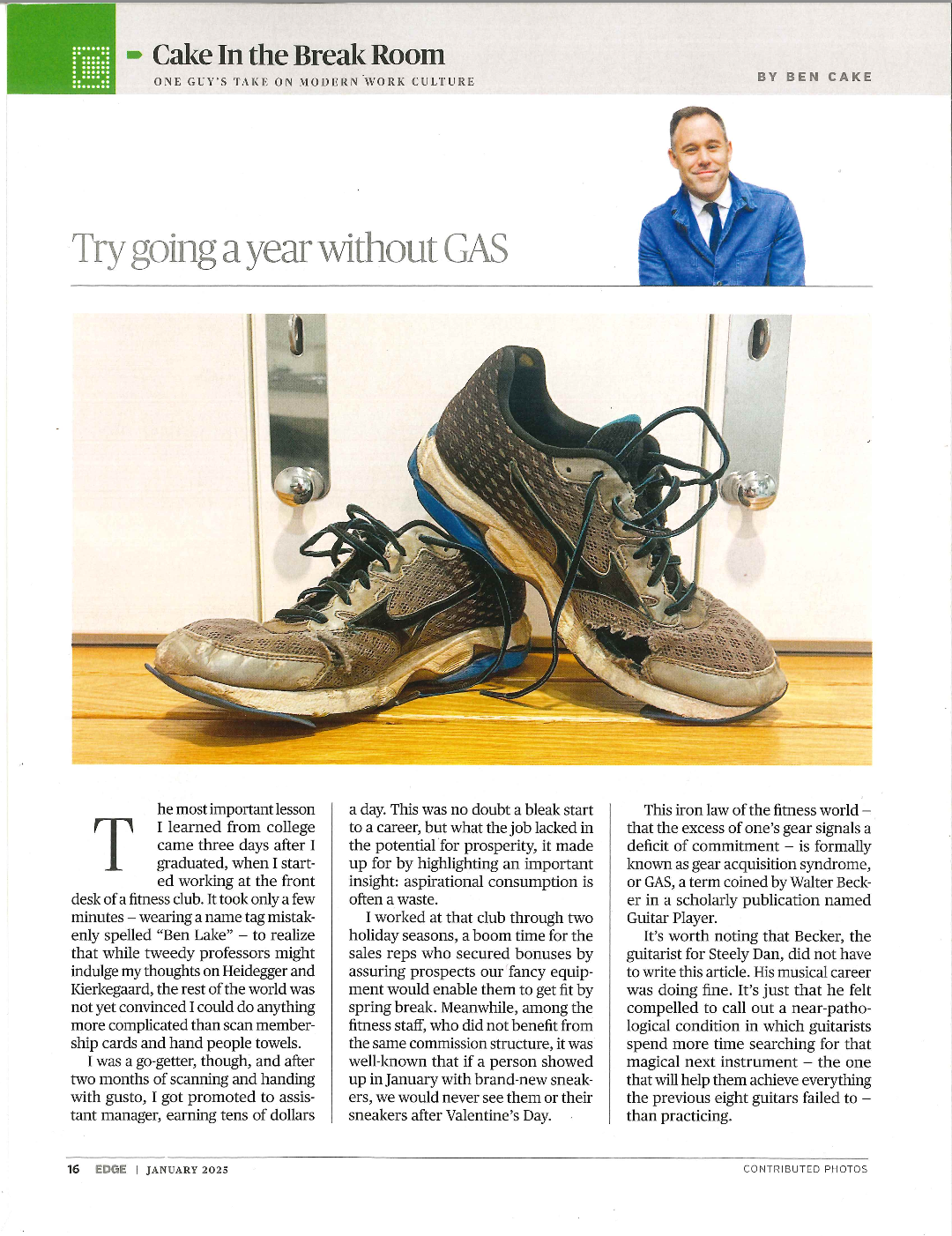
Speaking of messy, take a look at the sneakers in the photograph above. They are so hideous, hole-ridden, and rank that my family makes me keep them on the porch. They got that way because I’ve worn them to exercise an average of 229 days a year, for the past nine years. During that time, complete strangers have suggested it was time for a new pair. But this comment—along with their brand-new Hokas—was proof those folks didn’t know what they were talking about.
Ugly sneakers work fine if you’re willing to make an effort. In fact, they become ugly because of that effort. The holes you see, for example, were caused by the pedals on a stationary bike. A new pair would develop the same holes in a matter of weeks, rendering the purchase pointless.
Therein lies the most significant reason effort is more effective than acquisition: once that effort begins, the romantic ideas drain away, and all you’re left with is an activity, as well as the understanding that you didn’t need all the things you thought you needed before you began.
Eventually, I will have to buy a new pair of ugly sneakers. In the process, I’ll get bombarded with blue-sky descriptions of various features engineered to provoke an onset of GAS. But, as with an overpriced education or an overbuilt software platform, I’ll know all that promise is just hot air.