FOR THE PAST TWO DECADES, our country’s high-profile entrepreneurs have been busy spinning utopian visions of the future, so it’s surprising to see a recent trend of people looking backward: All the talk about the dot-com bubble, for instance, or Nvidia’s memo explicitly stating it’s not Enron (the company that, in 2001, lost more than $60 billion in value and filed for bankruptcy due to accounting fraud).
Could this shift in focus signal a crisis of confidence? Or is it simply a sign we’re recovering from the amnesia of the 2010s?
It was in that frothy decade that I wandered into the world of start-ups amid its baffling “Uber for X” period. Much the way anyone eager for investment capital in 2026 throws “AI” into their pitch deck, back then everyone jumped on the bandwagon of an Uber-like “platform.” Thus, I found myself surrounded by people who began every other sentence with “Well, when I was at Uber…,”and whose memories didn’t span further back than 2012.
Then, as now, this rah-rah attitude struck me as strange. I’d only ever worked at companies that relied on making money, so I couldn’t fully fathom the genius behind a place that operated at a loss of $2.6 billion in 2015, $3.8 billion in 2016, $4.5 billion in 2017, and $3.9 billion in 2018. When Uber’s IPO was broadly labeled a “train wreck,” I finally had to ask one of these ex-Uber guys to make sense of matters.
“I’m not worried,” he told me. “Uber’s basically a utility now.”
Oh, dang. To him, Uber was a service the world could not do without, on the level of water, gas, and electricity. I found this opinion fascinating, because it meant he had no memory of the Great Recession, when the terms “1 percent” and “99 percent” were popularized and the term “too big to fail” was often uttered with a great deal of anger.
In his book Too Big to Fail, Andrew Ross Sorkin highlighted the dilemma members of the Treasury and Federal Reserve faced as they sought to minimize “the disruption in the capital markets” due to bad bets made by financial titans: On the one hand, they sought to prevent the widespread collapse of the economy. On the other hand, they feared the potential for “moral hazard”—a term described as “what happens when risk takers are shielded from the consequences of failure…ever-greater risks.”
What’s perhaps most striking about that crisis was that for the better part of a year, the biggest brains in finance could only come up with two possible solutions: Someone needs to buy the distressed companies, or someone needs to give them more money.
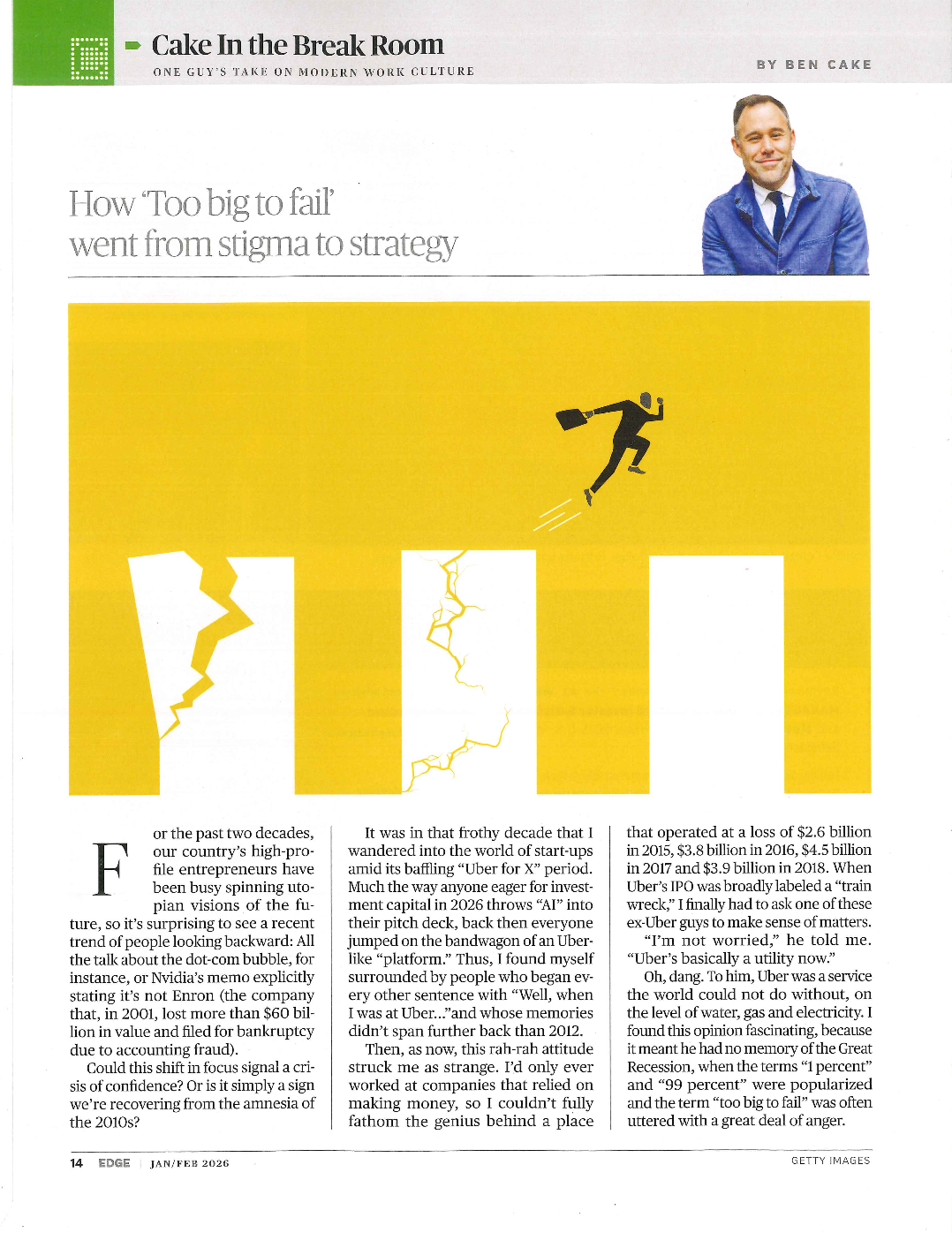
Ultimately, the government deployed about $500 billion to prop up the failing institutions and pull America back from the brink. It was a functional victory, but aside from some op-ed shaming, it did not succeed in promoting caution or accountability. And with interest rates remaining below 1 percent until 2017, “too big to fail” went from stigma to strategy, and “more money” went from an unfortunate solution to the only solution.
Hence, my colleague’s confidence that investment capital could continue forever.
Yes, it was crazy, but the 2010s was an era when SoftBank CEO Masayoshi Son gave WeWork founder Adam Neumann $4.4 billion and told him, “You are not crazy enough.”
Neumann—who was already plenty crazy—took this to heart, and went completely nuts. By 2019, his company was operating at a loss of $219,000 an hour, and a WeWork executive told The New Yorker that dealing with him was like “babysitting a pyromaniac.”
Eventually, WeWork proved it wasn’t too big to fail and filed for bankruptcy. But now we have something even bigger: OpenAI has raised more than $60 billion since its founding in 2015, and some reports estimate it’s operating at a loss of $625,000 an hour, which makes Sam Altman’s recent efforts to cuddle up with the government the least-surprising move ever.
Maybe, just maybe, the reason so many folks are suddenly looking backward is because they can’t bear to see what happens next. One way or another, it promises to be crazy.