I ONCE WORKED WITH a talented website designer who was so crippled by office dynamics that he rarely designed anything at all. Instead, he would create sketches and wireframes (essentially, design outlines), and then begin every presentation meeting with, “This is…ah…all still very high level.”
He did this because, either consciously or subconsciously, he recognized the leadership team we presented to could not agree on the fundamental strategy or direction of the company, let alone specifics. As a result, he knew what he presented would not get discussed as work but rather function as an object the leadership team could point at while asserting their opinions without having to address the bigger issues at play. (Much the way couples might argue about the dishes even though it’s never about the dishes.)
The designer understood that nothing he made would get any further than suffering the collateral damage of that debating, so his answer was to avoid investing in the details. Meanwhile, like a dummy, I showed up to these meetings with fully fleshed-out work, which was routinely shredded.
I watched this pattern repeat itself for months, and prior to each meeting, I would think, This is going to be the one where someone says, “How long are we going to stay at a ‘high level’? When are we going to see some work?”
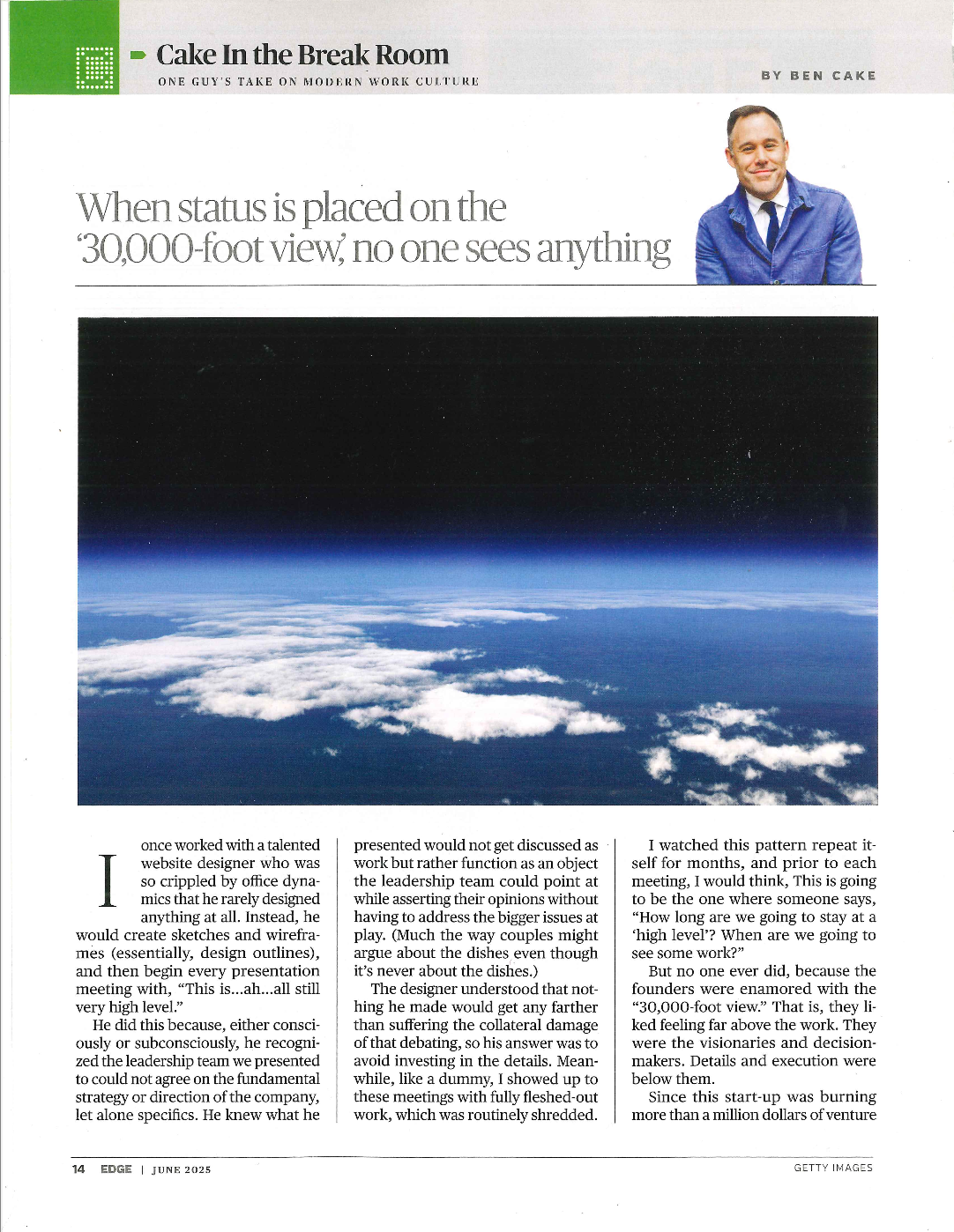
But no one ever did, because the founders were enamored with the “30,000-foot view.” That is, they liked feeling far, far above the work. They were the visionaries and decision-makers. Details and execution were below them.
Since this start-up was burning more than a million dollars of venture capital a month, eventually there would be a frantic moment in which something had to get done. A project would become, in the lingo of the day, “priority zero.” Then you could find members of the leadership team standing at the designer’s desk, “weighing in,” which more or less meant directing the design in real time. It turned what could’ve been a methodical production process into something more like a last-minute improv show, until, exhausted, we were left with a Frankenstein monster of differing opinions that would make no sense to the wider world.
Much has been said about the perpetual friction between “architects” and “contractors,” highlighting how what seems perfect when drawn in an office filled with Eames chairs doesn’t always translate cleanly to the reality of a job site. In fact, so many business books address this, sometimes swapping in “engineers” and “manufacturing people,” that the issue has become common knowledge. As has the general solution, which I’m borrowing here from the book Made to Stick: “…problems should be solved at the level of the machine.”
That is, the visionaries should get their heads out of the clouds.
But what many of these business-book authors overlook when they prescribe this solution is that their advice, in its abstraction, is its own kind of engineering blueprint that’s distant from reality.
And the reality is that we’re dealing with people—and those people, like everyone, have fears and fragile egos. A lot of status has been conferred to the idea of those who see the “big picture” and can walk into a room and solve problems with charm and insight. It’s a very attractive idea. And once someone gets a taste of the air at 30,000 feet, they become hesitant to lower themselves to the level of the machine, where their ideas might not work. There’s also the concern that once they spend time at ground level, everyone else is going to think they have a right to get on the plane that takes the leader back up to 30,000 feet.
The practical answer—as seen in the moments of “weighing in”—isn’t that leadership should get on the production line and “show ’em how it’s done.” Businesses need both their architects and their contractors, but it also needs to celebrate (or at least respect) the value each role provides.
Because when we glamorize the 30,000-foot view at the expense of those on the ground, everyone ends up flying blind.