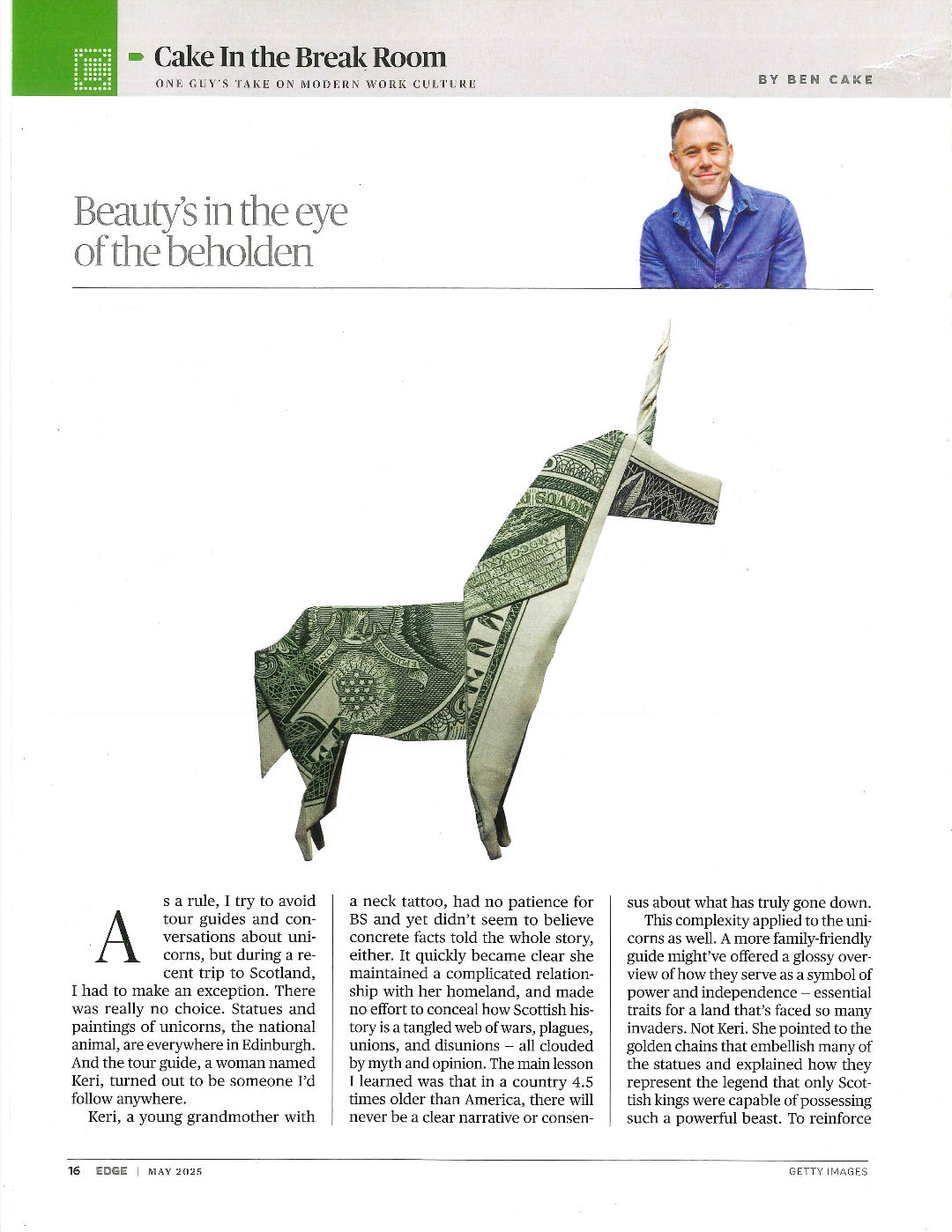
AS A RULE, I TRY TO AVOID tour guides and conversations about unicorns, but during a recent trip to Scotland, I had to make an exception. There was really no choice. Statues and paintings of unicorns, the national animal, are everywhere in Edinburgh. And the tour guide, a woman named Keri, turned out to be someone I’d follow anywhere.
Keri, a young grandmother with a neck tattoo, had no patience for BS and yet didn’t seem to believe concrete facts told the whole story, either. It quickly became clear she maintained a complicated relationship with her homeland, and she made no effort to conceal how Scottish history is a tangled web of wars, plagues, unions, and disunions—all clouded by myth and opinion. The main lesson I learned was that in a country 4.5 times older than America, there will never be a clear narrative or consensus about what has truly gone down.
This complexity applied to the unicorns as well. A more family-friendly guide might’ve offered a glossy overview of how they serve as a symbol of power and independence—essential traits for a land that’s faced so many invaders. Not Keri. She pointed to the golden chains that embellish many of the statues and explained how they represent the legend that only Scottish kings were capable of possessing such a powerful beast. To reinforce this belief, she continued, kings would often commission soldiers to go on long “unicorn hunts.”
Keri, being Keri, then said she did not think anyone involved in these government-sponsored unicorn expeditions actually believed unicorns existed. They were just a pragmatic reinforcement of the era’s power structures.
In Keri’s eyes, the kings simply wanted to confirm their soldiers would do ridiculous things because they said so. The soldiers, meanwhile, were happy to walk around in the woods, looking for an animal they knew wasn’t there, as long as the royal paychecks kept getting signed. Put plainly: It was a historic example of bought loyalty.
As I listened, all I could think about was the insincerity and waste found in many of today’s tech start-ups—right down to the fixation on “unicorns.”
For the rest of the trip, in fact, I kept recalling an equally absurd ceremony I had to endure at one such start-up: Each week, the company held an all-hands meeting that began with a member of the C-suite hitting “record” on his phone, at which point the staff was required to stand up and chant the name of a preselected employee in the rowdy cadence of fraternity brothers shouting “Chug! Chug! Chug!” This would build until the staff broke into wild shouting and applause. The C-suite guy would then stop recording and send the video to the employee so they felt seen and appreciated.
This charade was intended to boost morale and reinforce company values, but what each week’s video did not capture was how quickly the smiles and chanting died once the recording stopped. Nor did it capture the shared sense of humiliation most of the staff felt about the mandate to indulge one person’s idea of a good time. Several co-workers referred to it as a “company-led fake orgasm.” Over time, sick of it, more and more people found excuses to work from home on the days all-hands meetings were scheduled.
I mention all this because hard power and economic coercion have come back into vogue these days. As a result, we’re likely to witness a bewildering uptick in ring-kissing and rah-rah pageantry. And the key to maintaining one’s dignity (and sanity) will involve recognizing how most of it is just a performance.
Because while money can buy people’s time, which for brief periods can resemble loyalty, history has shown it can’t buy true buy-in.