I’M NOT SURE WHAT I DID to anger the algorithm gods, but over the past couple weeks, I’ve encountered more than a dozen articles touting the “brilliance” of Gary Dahl, the inventor of the Pet Rock. Each of these articles offers a near-identical summary of Mr. Dahl’s unconventional path to riches, and then concludes with advice about how “a great story can sell anything!”
The trouble is, the Pet Rock wasn’t really a product, nor was it sold with a “story.” It was a joke—which seems to have gone over the heads of these “thought leaders.”
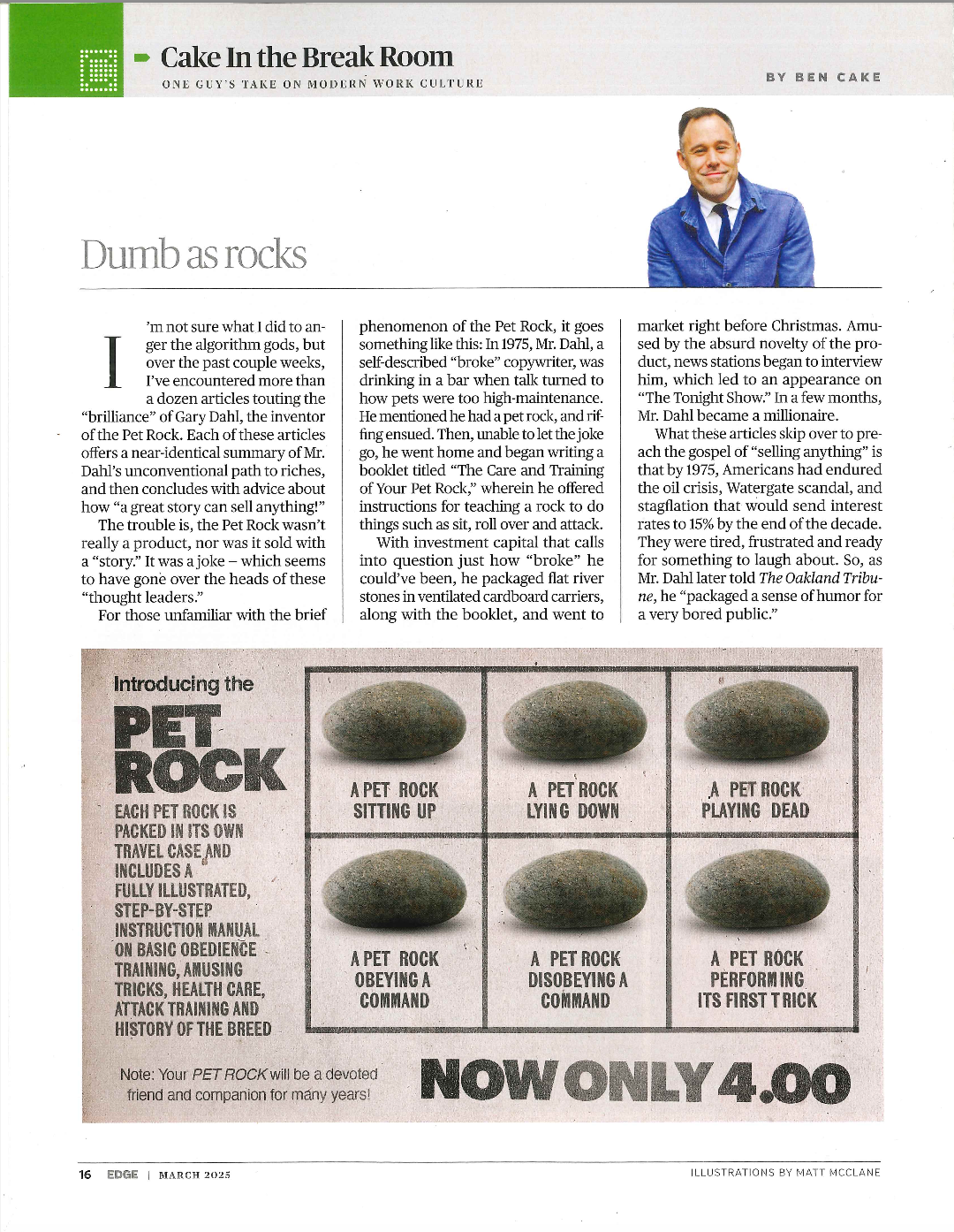
For those unfamiliar with the brief phenomenon of the Pet Rock, it goes something like this: In 1975, Mr. Dahl, a self-described “broke” copywriter, was drinking in a bar when talk turned to how pets were too high-maintenance. He mentioned he had a pet rock, and riffing ensued. Then, unable to let the joke go, he went home and began writing a booklet titled “The Care and Training of Your Pet Rock,” wherein he offered instructions for teaching a rock to do things such as sit, roll over, and attack.
With investment capital that calls into question just how “broke” he could’ve been, he packaged flat river stones in ventilated cardboard carriers, along with the booklet, and went to market right before Christmas. Amused by the absurd novelty of the product, news stations began to interview him, which led to an appearance on “The Tonight Show.” In a few months, Mr. Dahl became a millionaire.
What these articles skip over to preach the gospel of “selling anything” is that by 1975, Americans had endured the oil crisis, Watergate scandal, and stagflation that would send interest rates to 15 percent by the end of the decade. They were tired, frustrated, and ready for something to laugh about. So, as Mr. Dahl later told the Oakland Tribune, he “packaged a sense of humor for a very bored public.”
Here we see the joke, not the rock, was the product, and customers were in on it. One woman, in fact, returned her Pet Rock along with a note stating that it had died before she got it home from the store.
Today, however, Mr. Dahl’s profitable goofing has been reinterpreted into a study of “storytelling” and salesmanship. And customers have gone from being in on the joke to a punch line.
Take, for instance, last year’s social-media trend in which young men began chewing expensive, rock-like “fitness gum” that, one such brand explains, “empowers you to take control of your appearance” and begin a “journey toward a sharper, more defined facial profile.”
Dental professionals, meanwhile, have warned this “journey” would most likely lead to a waiting room, because the gum is capable of damaging fillings and causing painful TMJ disorders.
And in 2017, Gwyneth Paltrow’s company, Goop, began selling the Jade Egg, describing it as “a strictly guarded secret of Chinese concubines,” with which women can “harness the power of energy work [and] crystal healing” to bring “joy and well-being.” In plain language, Ms. Paltrow’s company was advising women to stick rocks in an opening other than their mouths—and pay $66 for the privilege.
I’ll hasten to say I’m not an expert on women’s health, but those who are quickly cried foul: One OB/GYN called Goop’s marketing “the biggest load of garbage” and another deemed it “biologically impossible.” Not long after, Ms. Paltrow’s company paid $145,000 to settle a lawsuit brought by a consumer-protection agency about “unsubstantiated” claims.
Perhaps, like the Pet Rock, this nonsense got its start in the 1970s. As America contended with its various crises, many economists—most notably, Milton Friedman—argued for aggressive deregulation, believing that order would be attained by the “wisdom of the free market,” and, more than providing any real value, “The Social Responsibility of Business Is to Increase Its Profits.”
Generally, the “wisdom of the free market” is a nice idea, but it only works if the market is, in fact, wise. Unfortunately, this quick survey of what people are getting up to with rocks these days throws that theory into doubt, leaving us to wonder whether we might ultimately be headed for another Stone Age.