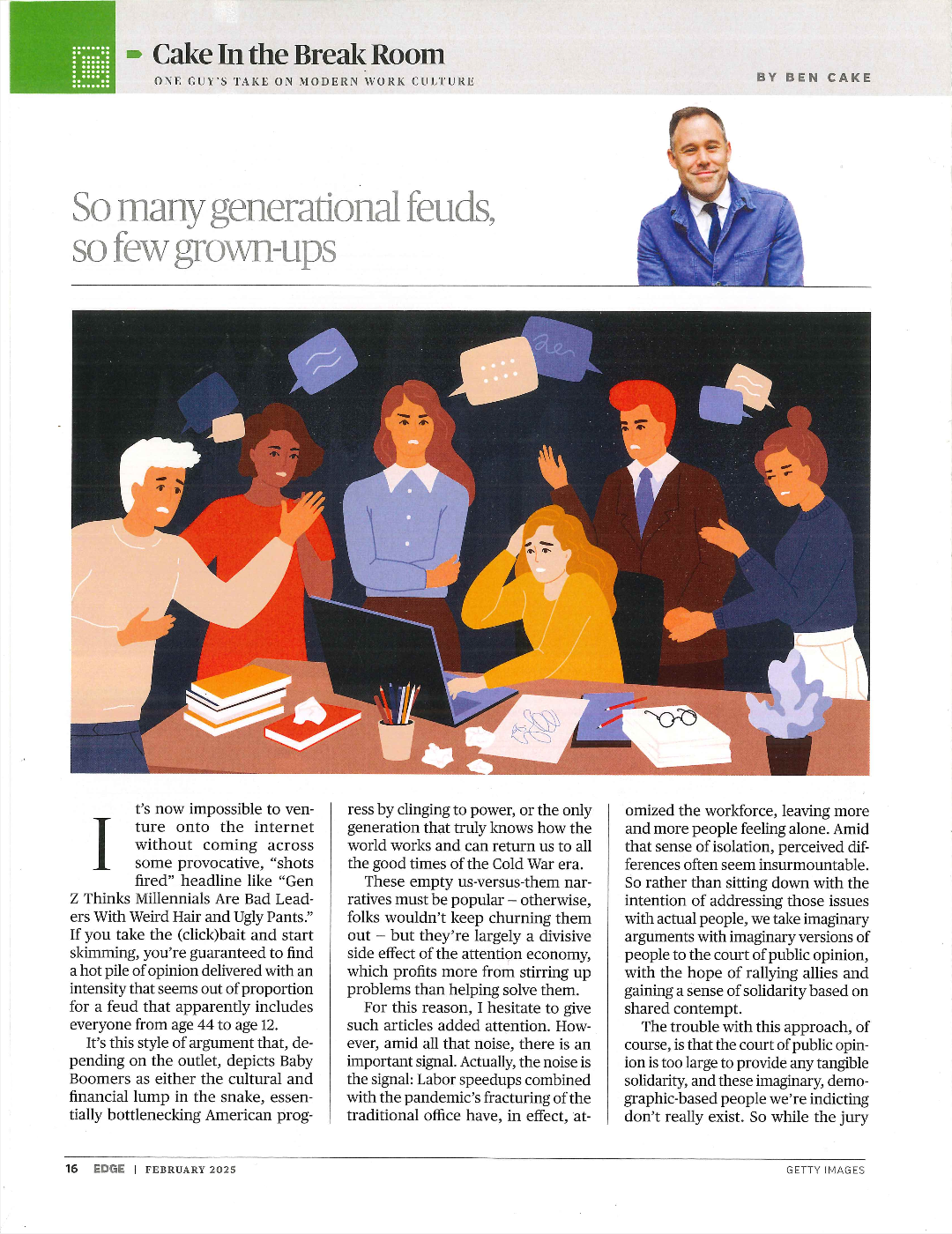
IT’S NOW IMPOSSIBLE to venture onto the internet without coming across some provocative, “shots fired” headline like “Gen Z Thinks Millennials Are Bad Leaders With Weird Hair and Ugly Pants.” If you take the (click)bait and start skimming, you’re guaranteed to find a hot pile of opinion delivered with an intensity that seems out of proportion for a feud that apparently includes everyone from age 44 to age 12.
It’s this style of argument that, depending on the outlet, depicts Baby Boomers as either the cultural and financial lump in the snake, essentially bottlenecking American progress by clinging to power, or the only generation that truly knows how the world works and can return us to all the good times of the Cold War era.
These empty us-versus-them narratives must be popular—otherwise, folks wouldn’t keep churning them out—but they’re largely a divisive side effect of the attention economy, which profits more from stirring up problems than helping solve them.
For this reason, I hesitate to give such articles added attention. However, amid all that noise, there is an important signal. Actually, the noise is the signal: Labor speedups combined with the pandemic’s fracturing of the traditional office have, in effect, atomized the workforce, leaving more and more people feeling alone. Amid that sense of isolation, perceived differences often seem insurmountable. So rather than sitting down with the intention of addressing those issues with actual people, we take imaginary arguments with imaginary versions of people to the court of public opinion, with the hope of rallying allies and gaining a sense of solidarity based on shared contempt.
The trouble with this approach, of course, is that the court of public opinion is too large to provide any tangible solidarity, and these imaginary, demographic-based people we’re indicting don’t really exist. So while the jury might rule in our favor that some group—based almost entirely on age—is the problem, we’re still alone, with nothing left to do but write them off.
Perhaps this is why we’ve seen such a surge in to-heck-with-you, go-it-alone individualism—whether it be employees quitting to become “solopreneurs,” employers pushing to replace staff with machines, or everyone in between talking about what they’d do with “eff-you money.” (And then we wonder why loneliness is considered an epidemic.)
Legitimate signs of workplace friction are everywhere. Simply look at the face of a friend when you ask them “How was work today?” (You know the expression that means you’re in for a long answer.) But this friction has nothing to do with what year people were born. If it were that simple, you would agree with everything people your age said and did.
So…no. It has nothing to do with age and everything to do with ideology and control and getting deemed right.
There’s a common therapy-speak platitude that goes, “Would you rather be happy or right?” And it’s as if we’ve collectively said, “Happy? You think it’s possible to be happy? In 2025? The closest anyone will ever get to happiness is that five-second period right after you’ve delivered a devastating burn.”
And that’s unfortunate because it filters down by example, and then if you’re unsatisfied with a specific coworker—let’s say Tom in accounting—it’s less likely Tom will ever have the benefit of a sincere discussion about your differences. Rather, without him even knowing it, he’ll be deemed typical of a certain generation and then put on some mental list of those who are disposable when push comes to shove.
If we’re going to break this vicious cycle, it’s time to leave the rhetoric aside and start having discussions—in-person, time-consuming, often frustrating discussions that turn our issues over and over until they’re as smooth as polished stones. In this age that’s fixated on efficiency, it’s easy to believe these conversations are just not worth it. But there’s a dividend that comes from giving someone that kind of time—even if it’s just a mutual decision about whether working together is feasible.
Someone has to lead with maturity, because all this finger-pointing isn’t a sign that anyone’s right. It’s just a sign that we need to grow up.